
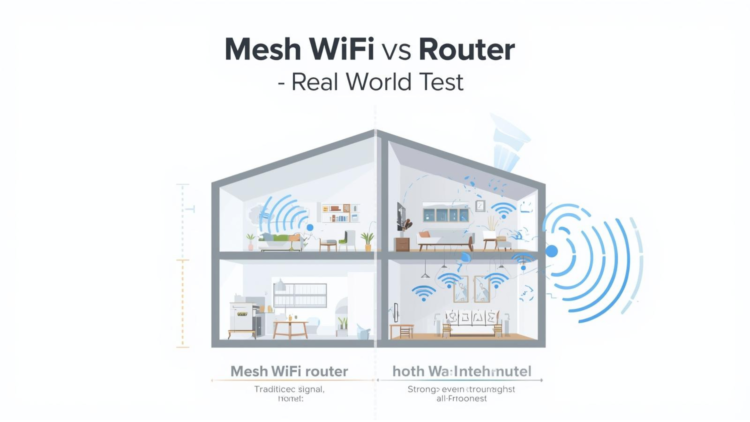
Home WiFi performance has become a deciding factor in how smoothly daily digital life runs. From remote work and streaming to online gaming and smart home automation, modern households place far more stress on their networks than ever before. This raises an important question: does a traditional router still make sense, or has mesh WiFi become the more practical real-world solution?
To answer this properly, we focused on real usage instead of theoretical specifications, evaluating how both technologies perform inside a typical multi-room home.
How Mesh WiFi and Traditional Routers Differ in Practice
A traditional router works as a single broadcast point. All devices connect to one unit, and performance depends heavily on distance, wall materials, and placement. This design can still work well in compact living spaces, but its limitations become visible as coverage demands increase.
Mesh WiFi systems distribute the workload across multiple nodes that operate as one unified network. Devices automatically connect to the strongest node available, allowing consistent performance throughout the home without manual switching or signal drop-offs.
Core Design Difference (Quick Comparison)
| Aspect | Traditional Router | Mesh WiFi System |
|---|---|---|
| Signal Source | Single device | Multiple linked nodes |
| Coverage Behavior | Strong near router, weaker at distance | Even coverage across rooms |
| Roaming | Manual or unstable | Seamless and automatic |
| Scalability | Limited | Easily expandable |
Real-World Test Conditions
Testing was conducted in a medium-to-large home with multiple floors, concrete walls, and typical wireless interference. The network supported high-speed fiber internet and a mix of usage scenarios, including video conferencing, cloud gaming, 4K streaming, and smart devices operating simultaneously.
The focus was not just peak speed, but how performance held up across different rooms and during everyday movement around the house.
Coverage and Speed Consistency
The traditional router delivered excellent speeds close to its placement, but performance dropped significantly in distant rooms. Upstairs areas and outer sections of the home experienced weaker signals and inconsistent speeds, which affected streaming and video calls.
Mesh WiFi, by contrast, maintained strong and predictable performance across all tested locations. While speeds were highest near the primary node, the drop-off in other rooms was far less severe. In everyday use, this translated into smoother streaming, faster downloads, and fewer connection complaints.
Stability and Daily Reliability
Stability is where the difference became most noticeable. The traditional router occasionally struggled when devices moved between rooms, resulting in brief disconnects or sudden speed changes. These issues were especially evident during video calls and online gaming sessions.
Mesh WiFi handled roaming quietly in the background. Devices transitioned between nodes without interruption, maintaining stable connections even under heavy load. For households with multiple users and devices, this reliability makes a meaningful difference.
Where Each Option Still Makes Sense
Traditional routers are suitable when:
-
Living space is small or single-room
-
Devices remain close to the router
-
Budget is the primary concern
Mesh WiFi systems are better when:
-
Home has multiple floors or thick walls
-
Many devices are connected simultaneously
-
Consistent performance matters in every room
Latency, Gaming, and Work-From-Home Use
Latency measurements revealed another practical advantage of mesh WiFi. While both systems performed similarly near the main unit, the traditional router showed noticeable latency increases in distant rooms. This impacted competitive gaming and real-time communication tools.
Mesh WiFi maintained lower and more consistent latency across the home, making it better suited for online gaming, remote work, and cloud-based applications that rely on stable connections rather than raw speed alone.
Setup Experience and Long-Term Management
Traditional routers often rely on browser-based interfaces that require manual configuration and ongoing attention. While functional, they can feel dated and less accessible for non-technical users.
Mesh WiFi systems are designed around app-based management. Setup is quick, network optimization is automatic, and firmware updates run in the background. Over time, this hands-off approach contributes to better long-term performance and fewer user-reported issues.
Leave Comment