
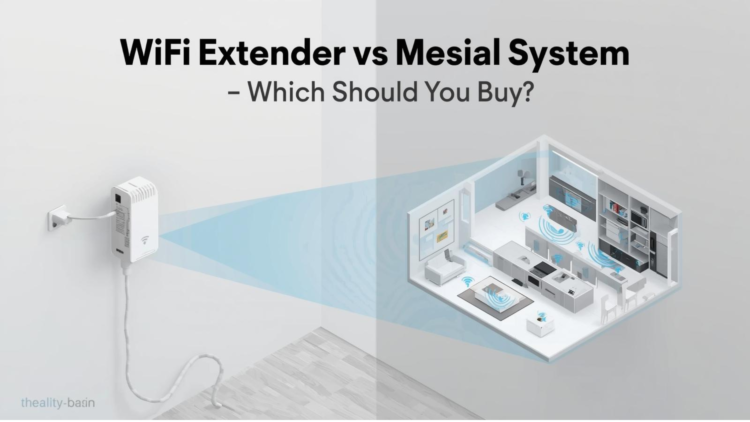
A strong and reliable WiFi connection has quietly become one of the most important utilities in a modern home. From video conferencing and cloud-based work to streaming, gaming, and smart home devices, almost everything now depends on stable wireless coverage. Yet for many users, WiFi performance still drops the moment they move a few rooms away from the router.
This is where the debate around WiFi extender vs mesh system begins.
Both solutions promise to fix weak signals and eliminate dead zones, but they work in very different ways and deliver very different real-world results. Choosing the wrong one can lead to wasted money, unstable connections, and long-term frustration. Choosing the right one can transform how your home internet feels on a daily basis.
This in-depth guide breaks down WiFi extenders and mesh systems from a real-world perspective—how they behave in actual homes, how they affect speed and reliability, and which option makes more sense depending on your needs, space, and budget.
Understanding the WiFi Coverage Problem
Before comparing solutions, it’s important to understand why WiFi problems exist in the first place. Most homes rely on a single router placed near the internet connection. That router broadcasts WiFi signals in all directions, but those signals weaken as they pass through walls, floors, furniture, and interference from other devices.
As distance increases, several issues appear:
-
Signal strength drops
-
Speeds decrease
-
Latency increases
-
Connections become unstable
In small apartments, this may never become noticeable. In larger homes, multi-story houses, or buildings with thick walls, these problems are almost unavoidable without additional hardware.
Both WiFi extenders and mesh systems exist to solve this exact problem—but they approach it very differently.
What Is a WiFi Extender?
A WiFi extender, sometimes called a repeater or range extender, works by receiving your existing WiFi signal and rebroadcasting it to extend coverage into weak areas. It acts as a middle point between your router and devices that are far away.
From a technical standpoint, the extender connects wirelessly to your router and then creates a secondary WiFi signal that devices can connect to.
In theory, this sounds simple and effective. In practice, it comes with trade-offs that many users only notice after installation.
How WiFi Extenders Work in Real Homes
Because an extender relies on the original router’s signal, its performance is directly tied to how strong that signal is at the extender’s location. If the extender is placed too far away, it simply repeats a weak signal. If placed too close, it adds little benefit.
Another important detail is that most extenders either create a separate network name or force devices to reconnect when moving between the router and extender. This can cause brief disconnections or inconsistent speeds as devices struggle to choose the correct signal.
Despite these limitations, extenders remain popular due to their low cost and simple purpose.
What Is a Mesh WiFi System?
A mesh WiFi system is a more modern approach to whole-home wireless coverage. Instead of one router and one or two add-ons, a mesh system uses multiple nodes that work together as a single network.
Each node communicates with the others, dynamically routing traffic along the most efficient path. From the user’s perspective, the entire home operates under one unified WiFi network, regardless of where you are.
Mesh systems are designed from the ground up to handle roaming, multiple devices, and large coverage areas without manual intervention.
How Mesh Systems Behave in Everyday Use
Unlike extenders, mesh nodes don’t simply repeat a signal. They actively manage traffic and connections, ensuring devices always connect to the best possible node. This results in smoother transitions between rooms, more consistent speeds, and fewer sudden drops.
The difference becomes especially noticeable in homes with multiple floors or heavy daily usage.
WiFi Extender vs Mesh: Core Design Differences
At a fundamental level, the difference between a WiFi extender and a mesh system comes down to architecture.
A WiFi extender is an add-on that tries to stretch the limits of a single router. A mesh system replaces that single-point design with a distributed network built for coverage and stability.
This distinction affects everything from speed behavior to long-term scalability.
Real-World Speed Performance
Speed is often the first metric users care about, but it’s also one of the most misunderstood.
Near the main router, both extenders and mesh systems can deliver excellent speeds. The real difference appears as distance increases.
WiFi Extender Speed Behavior
Because an extender must receive and retransmit data, many models effectively cut available bandwidth in half. In real-world use, this means that while coverage improves, speeds often drop noticeably in extended areas.
For casual browsing or messaging, this may be acceptable. For streaming, gaming, or work-related tasks, the speed loss can quickly become frustrating.
Mesh System Speed Behavior
Mesh systems are designed to minimize speed loss across nodes. Many modern mesh systems use dedicated backhaul channels or intelligent routing to preserve bandwidth.
In practical terms, this means that speeds remain more consistent throughout the home, even in rooms far from the primary node.
Coverage and Dead Zone Elimination
Coverage is where both solutions aim to help—but again, results differ.
WiFi extenders can improve coverage in specific areas, but they rarely eliminate dead zones entirely. Coverage often becomes uneven, with strong signals in some spots and weak or unstable connections in others.
Mesh systems, when properly placed, provide overlapping coverage that blankets the home. Instead of pushing a signal as far as possible, they distribute it intelligently. This leads to fewer dead zones and a more predictable WiFi experience.
Stability and Connection Reliability
Stability is often more important than raw speed, especially for video calls, remote work, and smart home devices.
WiFi extenders can introduce instability due to network switching and interference. Devices may cling to weaker signals longer than they should or bounce between networks, causing brief interruptions.
Mesh systems handle roaming automatically and seamlessly. Devices move between nodes without disconnecting, which significantly improves reliability during everyday movement around the house.
Latency and Gaming Performance
Latency-sensitive tasks highlight the differences between these two solutions very clearly.
With a WiFi extender, latency often increases as distance grows. Online games may experience higher ping, and real-time applications can feel less responsive.
Mesh systems maintain lower and more consistent latency across the home. Even in distant rooms, performance remains stable enough for competitive gaming and cloud-based applications.
Setup Experience and Ease of Use
Setup plays a surprisingly large role in long-term satisfaction.
WiFi extenders typically require manual placement experimentation. Finding the “sweet spot” between router and dead zone can take time, and settings often need adjustment through browser-based interfaces.
Mesh systems prioritize ease of use. Most are set up through mobile apps with step-by-step guidance. Nodes automatically optimize their connections, and firmware updates happen in the background.
For non-technical users, this difference alone can justify choosing mesh over an extender.
Scalability and Future-Proofing
One of the biggest limitations of WiFi extenders is scalability. Adding multiple extenders can create interference and further reduce performance. At some point, the network becomes more complicated without delivering better results.
Mesh systems are built to scale. Adding another node is straightforward and integrates seamlessly into the existing network. This makes mesh a better long-term solution for growing homes or increasing device counts.
Cost Considerations
Cost is often the deciding factor in the WiFi extender vs mesh debate.
WiFi extenders are significantly cheaper upfront. For users on a tight budget or with very specific coverage issues, this can be appealing.
Mesh systems cost more initially, but they often provide better value over time. Instead of replacing hardware, users can expand coverage incrementally. The improved reliability also reduces the need for troubleshooting and upgrades.
When a WiFi Extender Makes Sense
Despite their limitations, WiFi extenders still have a place.
A WiFi extender can be a reasonable choice if:
-
The home is small or medium-sized
-
Only one or two areas need better coverage
-
Internet usage is light
-
Budget is very limited
In these scenarios, an extender can provide a noticeable improvement without significant investment.
When a Mesh System Is the Better Choice
Mesh systems are the superior option in many modern households.
A mesh system is the better choice if:
-
The home has multiple floors or thick walls
-
Several people use the network simultaneously
-
Online gaming or remote work is common
-
Smart home devices are widely used
-
Long-term reliability matters more than upfront cost
For these users, mesh WiFi doesn’t just extend coverage—it fundamentally improves how the network behaves.
Leave Comment