
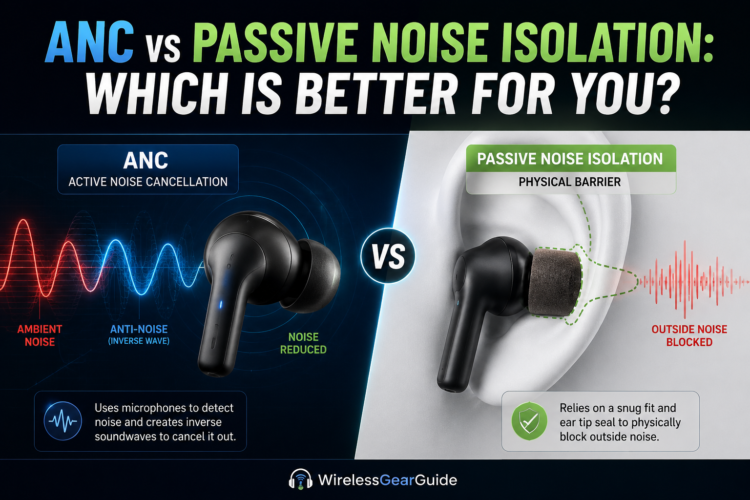
When you’re buying headphones or earbuds, you’ll often see two noise-blocking technologies mentioned: Active Noise Cancellation (ANC) and Passive Noise Isolation. Many people think they’re the same thing or that ANC is simply better but that’s not always true. The right choice depends entirely on your use case.
WirelessGearGuide.com breaks down both technologies in depth, explaining how each works, where each excels, and which scenarios call for each approach.
What is Passive Noise Isolation?
Passive noise isolation is the simplest form of noise blocking. It uses physical barriers the ear cups, ear tips, or headband padding to physically block sound from reaching your ears. There’s no electronics involved. It works by creating a seal around or in your ear canal that sound waves can’t easily penetrate.
The effectiveness of passive isolation depends heavily on fit. A tight-sealing in-ear earphone with silicone or foam tips can block 15-30dB of ambient noise. Over-ear headphones with thick ear pads can block 10-20dB. This is particularly effective against mid and high-frequency sounds (voices, traffic, machinery).
What is Active Noise Cancellation (ANC)?
ANC is an electronic system that actively generates anti-noise sound waves that are 180 degrees out of phase with the ambient noise. When these anti-noise waves meet the incoming noise waves, they cancel each other out through a phenomenon called destructive interference.
How ANC Works Step by Step
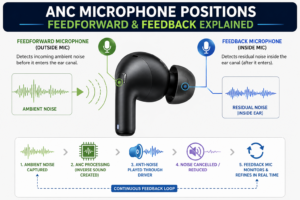
- Microphones outside the ear cup (feedforward mics) sample the ambient noise around you
- A dedicated ANC processor analyzes the noise wave in real time
- The processor generates an inverted copy of the noise wave (anti-noise)
- The anti-noise is mixed into your audio output
- Anti-noise meets the original noise in your ear canal and cancels it out
- An inner microphone (feedback mic) checks the residual noise and fine-tunes the cancellation
Types of ANC
Feedforward ANC
Only uses external mics. Fast response time but less precise. Works well for consistent, predictable noise like airplane engines or HVAC systems. Less effective against sudden or irregular sounds.
Feedback ANC
Only uses internal mic inside the ear cup. More accurate in low frequencies but slower to react. Found in older or lower-cost ANC implementations.
Hybrid ANC
Combines both feedforward and feedback approaches. Uses multiple microphones and a more powerful processor. Found in premium headphones like Sony WH-1000XM5, Bose QC45, and Apple AirPods Pro 2. Provides the most comprehensive noise cancellation across all frequencies.
ANC vs Passive Isolation: Head-to-Head
| Factor | ANC | Passive Isolation |
| Best Against | Low-frequency drone (engines, HVAC) | Mid/high-frequency noise (voices, traffic) |
| Electronics Required | Yes | No |
| Battery Impact | Reduces battery life 20-40% | None |
| Sound Quality Effect | Can cause pressure sensation | Depends on fit/seal quality |
| Cost Premium | Yes, adds $30-$150 | Minimal |
| Effectiveness in Wind | Often worse — mics pick up wind | Better |
Which Should You Choose?
Choose ANC If…
- You fly frequently and want to block out airplane engine drone
- You work in an open office with constant background HVAC or chatter
- You want to listen at lower volumes (ANC reduces need to crank volume)
- You’re willing to pay a premium for the technology
Choose Passive Isolation If…
- You want simpler, more battery-efficient earphones
- Your primary noise concern is voices and mid-frequency sounds
- You need protection from sudden loud noises (ANC doesn’t respond fast enough)
- Budget is a primary concern
Can You Have Both?
Yes. Most modern ANC headphones also provide passive isolation through their physical design. In fact, you should always look at the passive isolation performance when buying ANC headphones. The Sony WH-1000XM5, for example, provides -20dB of passive isolation on top of its ANC. This combination is why it blocks out so much more noise than cheaper ANC headphones with poor passive sealing.
Related: Best Wireless Earbuds 2026: Top Picks for Every Budget — WirelessGearGuide.com
Related: Best Wireless Headphones 2026: Over-Ear Buying Guide — WirelessGearGuide.com
Related: How Bluetooth Works: Complete Wireless Audio Technology Guide — WirelessGearGuide.com


Leave Comment