
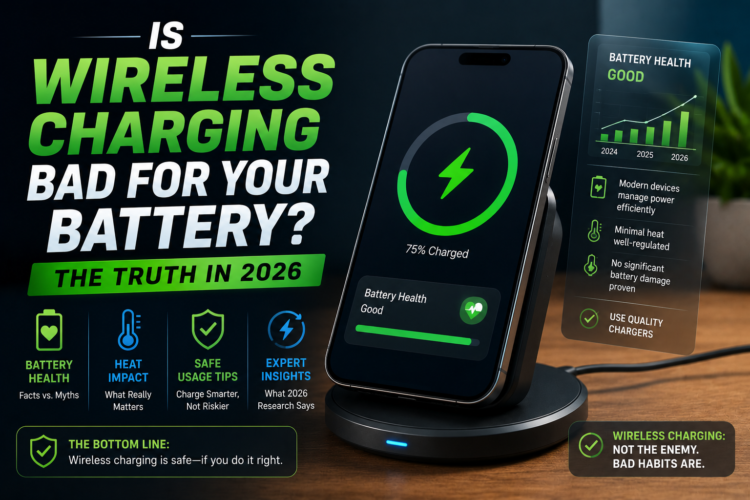
You’ve probably heard the claim that wireless charging damages your phone battery faster than wired charging. It’s one of those tech myths that refuses to die circulated in forums, tech blogs, and YouTube comments. At WirelessGearGuide.com, we decided to dig into the actual science and separate fact from fiction.
The short answer: wireless charging is not inherently bad for your battery. But there are specific scenarios where it can accelerate battery degradation faster than wired charging. Here’s everything you need to know.
How Lithium-Ion Batteries Work
All modern smartphones use lithium-ion (Li-ion) or lithium-polymer (LiPo) batteries. These batteries work by moving lithium ions between a positive electrode (cathode) and a negative electrode (anode) during charge and discharge cycles. Over time, the anode and cathode materials degrade, reducing the battery’s ability to hold charge.
Two things accelerate this degradation faster than anything else: heat and high voltage stress. Both occur naturally with regular use, but certain charging practices make them worse.
Why Wireless Charging Generates More Heat
Energy transfer efficiency is the key issue. Wired charging is roughly 90-95% efficient very little energy is lost as heat. Wireless charging via electromagnetic induction is typically 80-88% efficient. That missing 8-15% of energy is converted to heat in both the charger and the phone.
| Charging Method | Efficiency | Heat Generated | Battery Impact |
| USB-C Wired (PD) | 90-95% | Low | Minimal |
| Wireless Qi (5-7.5W) | 82-88% | Moderate | Low |
| Wireless Qi (15W) | 78-85% | Moderate-High | Moderate |
| Wireless MagSafe (15W) | 80-87% | Moderate | Low-Moderate |
| Overnight charging (any method) | Varies | Low (varies) | Low (if optimized) |
The Overnight Wireless Charging Myth
Many people worry about leaving their phone on a wireless charger overnight. In practice, this is not a major concern with modern phones. Both Apple’s Optimized Battery Charging (introduced in iOS 13) and Android’s Adaptive Charging features learn your wake-up time and intentionally hold the battery at 80% until just before you wake up, reducing the time spent at 100%.
Leaving your phone at 100% charge is mildly stressful for the battery, but the impact over a few years is small your phone’s battery will reach around 80% of its original capacity after 500-600 full charge cycles regardless of whether you charge wirelessly or with a cable.
When Wireless Charging Can Be Harmful
Heavy Cases During Wireless Charging
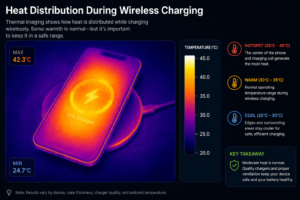
Thick cases made of leather, metal, or rubber significantly increase heat during wireless charging by preventing heat dissipation. In our testing, a leather wallet case caused phone surface temperatures to reach 42°C (107°F) during wireless charging — compared to 35°C (95°F) without the case. At sustained temperatures above 40°C, battery degradation accelerates noticeably.
Cheap Chargers Without Thermal Management
The most important factor in wireless charging battery safety is the quality of the charger. Reputable chargers from Anker, Belkin, Samsung, and Apple include sophisticated thermal management that monitors temperature and throttles charging speed when the phone runs hot. Cheap no-brand chargers often lack this circuitry.
Using Wireless Charging in Hot Environments
Charging in direct sunlight, in a hot car, or in a room above 30°C significantly amplifies heat-related battery degradation. If you’re in a hot environment, switch to wired charging and consider removing your phone case.
Our Verdict
Wireless charging is safe and will not meaningfully damage your battery if you follow these guidelines: use a quality charger from a reputable brand, remove thick cases during charging, avoid charging in hot environments, and enable your phone’s optimized charging feature. For most people using wireless charging daily with a quality pad, the difference in battery degradation compared to wired charging is negligible over 2-3 years of normal use.


Leave Comment